
Product companies debating whether to invest in a PIM or a DAM are often asking the wrong question. The research suggests the more useful question is: what does it cost when you have one without the other, and why does having both still fall short for most manufacturers?
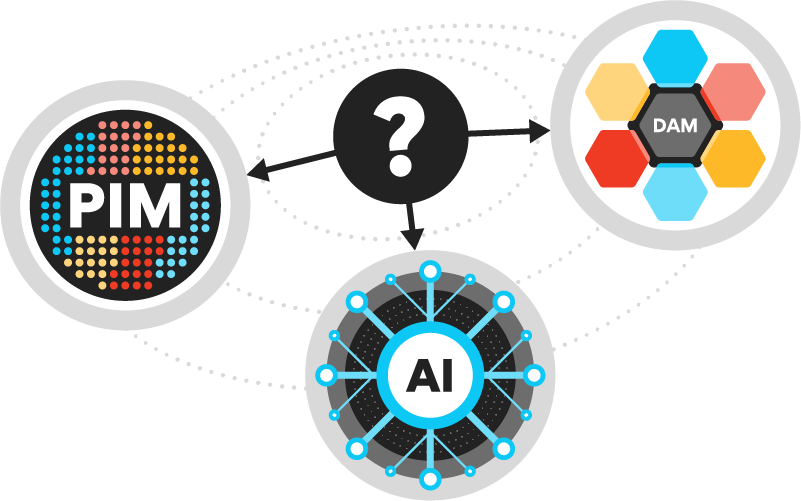
Our study of 100 industrial manufacturing leaders found that 68% have a PIM system and 58% have a DAM system. But the segment with both tools in place reveals a counterintuitive finding: having both is not enough.
The both-tools paradox
In the study, 45% of respondents had both a PIM and a DAM system. In theory, that group should be the most operationally capable. In practice, the data tells a different story.
Only 9% of people with both tools said they are effective at reducing manual effort in moving product data between systems. That is lower than the overall study average and reflects a consistent pattern: more technology creates more integration work, not less.
This group also reports the lowest rate of full integration of any segment (just 9%) and is most likely to cite too many overlapping tools as a top barrier (64%). Having more tools on the stack creates more integration debt, not more capability.
“We want to use a single central system to manage product data and automatically sync it across all channels, so the information stays consistent everywhere.”
Director, Marketing, Materials and Packaging Manufacturer
SURVEY RESPONDENT
What this group is missing
The problem isn’t the tools. It’s the integrations (or lack thereof) between them.
PIM and DAM working as separate systems doesn’t constitute PXM. Product experience management requires those systems to be connected to each other and to the rest of the tech stack—ERP for master product records, PLM for specs and compliance documentation, and downstream channels for consistent distribution. When those connections are absent or manual, the full potential of both systems goes unrealized.
This results in higher complexity than a single-system environment, without the operational benefit that integration would deliver.
Without either system: the AI question
The study also looked at manufacturers with neither a PIM nor a DAM in place. Naturally, none of those respondents reported full integration. Their most-cited barrier for this category is budget or ROI difficulty, at 63%.
Notably, these respondents are implementing AI at roughly the same rate as their better-equipped peers. That raises a pointed question: what foundation are those AI investments being built on? If AI tools are surfacing inconsistent product information in their outputs, how will those organizations correct it before it affects the business?
What the data shows about integration and AI maturity
The study did not directly measure organizations with fully integrated PIM and DAM because so few exist (7% overall). But the cross-sectional analysis of AI maturity provides a directional signal.
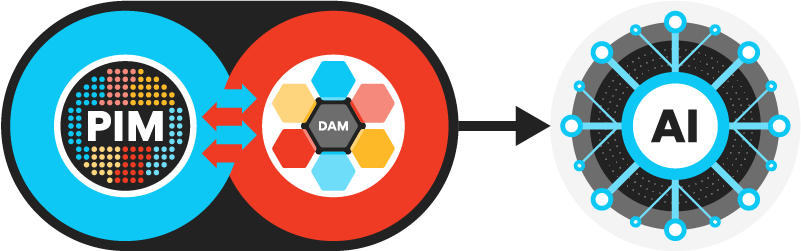
Among manufacturers with mature AI implementations, 36% have fully integrated product information systems. Among those just beginning AI, 3% are fully integrated. The AI-mature organizations are more likely to have done the integration work first, suggesting that connecting PIM and DAM as a unified system creates conditions for AI progress.
The implication for investment decisions
For CMOs and CIOs evaluating PXM investment, the data support a clear prioritization of both PIM and DAM working as an integrated system, connected to ERP and PLM upstream and to all downstream channels.
Those integrations and automated workflows are where the value gets unlocked. It’s also where most manufacturers are not yet investing.
The lesson from the research is straightforward. Manufacturers don’t gain a competitive advantage by buying more systems. They gain it by connecting them. As AI becomes increasingly dependent on structured, trusted product content, integration is shifting from an IT initiative to a competitive business capability.
This full study, including the complete segmentation analysis across PIM-only, DAM-only, both, and neither groups, is available free here.