
I’ve been in a lot of Life Sciences RFP conversations, and the briefing documents almost always describe the same problem: too many channels, too much rework, too slow to market. The ask is usually some version of “we need a better DAM” or “we need our PIM to talk to our content management system.”
What those briefs rarely say is that the real constraint isn’t the platform. It’s the approval process that the platform has to serve.
When a Life Sciences organization asks for faster content operations, what they’re really describing is a symptom. The underlying condition is that no content can move until Medical, Legal, and Regulatory have cleared it.
The tools are not the problem
Most Life Sciences marketing organizations we talk to are not underinvested in technology. They have a DAM. They have a PIM or a CMS. Several have unified a single source of truth for content, and a few have all of the above, integrated at varying degrees of completeness.
The issue here isn’t that they’re missing software. It’s that their systems were implemented for content velocity, and their governing workflows are built for defensibility.
That workflow is MLR: Medical, Legal, and Regulatory review. Depending on the organization, it might be called PRC, MAP, Copy Review, or Regulatory Affairs review.

While the name varies, the function doesn’t. Across the industry, before any promotional or scientific content reaches a physician, a patient, a distributor, or a digital channel, someone with authority must sign off on the accuracy, legality, and compliance of what you’re saying.
That’s the reality of the operating environment. As a result, every PXM implementation in Life Sciences has to be designed around it.
Where time actually goes – revise and withdraw
Teams that have mapped their own MLR cycle times almost always find the same two places where time disappears.
The first is revision. In most organizations, the review cycle doesn’t stall because reviewers are slow. It stalls because what they receive isn’t structured to support fast decisions. A reviewer looks at a new asset and has to manually verify that the clinical claim is tied to an approved reference. They have to confirm that none of the content has drifted from its approved version and that the included disclaimer is current for the market.
When that evidence isn’t surfaced at the point of review, the clock stops. When it has to be chased down, the reviewer must ask Marketing for more information.
Most organizations treat this bottleneck as a reviewer problem, but it isn’t. It’s an input problem. Your platform shouldn’t send an asset without the evidence reviewers need to approve it. You don’t need faster reviewers. You need to restructure what goes into review so that first-submission approval becomes the norm rather than the exception.
The second failure point is withdrawal. This one is quieter, which is why it tends to go unaddressed longer. When an asset expires or a claim is superseded, the DAM record gets updated. But the asset that was distributed six months ago is still sitting in the CRM email template library. It’s still on the regional affiliate’s SharePoint. It’s still in the training module that a new sales rep completed last week.
All this means that your organization is out of compliance, and no one is tracking it because the workflow that governs creation and approval doesn’t extend to distribution and expiry.
This is the compliance exposure I see most often underestimated in RFPs. Businesses scope for fast approval, but they overlook governed retirement. Then, an inspection later on surfaces a product claim that was formally withdrawn eighteen months ago, yet it’s still appearing in automated emails.
Withdrawal automation isn’t a nice-to-have. At scale, it’s the only defensible answer. Manual withdrawal processes—tracked in spreadsheets and executed through email chains—can’t keep pace with the volume of content that a mature Life Sciences PXM program generates. They also leave no audit trail that Regulatory Affairs can rely on.
Why generalist PXM implementations fail in Life Sciences
When a generalist DAM or PIM implementer approaches a Life Sciences engagement, they typically do three things well.
1) They configure the platform for metadata completeness.
2) They build integrations to syndication channels.
3) They set up a content workflow that routes assets from creation to approval to distribution.
What usually doesn’t get addressed is the MLR workflow. It’s often framed as a third-party process that the platform integrates with, versus the central design constraint that the platform has to serve.
The result is predictable. The platform goes live. Marketing Operations uses it but MLR reviewers don’t. They keep working in email and spreadsheets because the system doesn’t answer their actual needs. It doesn’t give reviewers the evidence they need. It doesn’t account for different tiers of risk, and it doesn’t provide Regulatory Affairs with the audit trail they’re responsible for maintaining.
As a result, adoption stalls. The business ends up with an expensive platform running in parallel with the informal approval process that never went away. Twelve months later, someone is writing an RFP for a new system.
Companies that avoid this pattern share one thing in common. They designed their PXM implementation around the MLR process and the content creation process, not one or the other.
What a functioning trust framework requires
When new SKUs hit every channel on day one, you capture demand instead of leaving it on the table. With PXM, we’ve helped clients decrease their time to market by 50%.
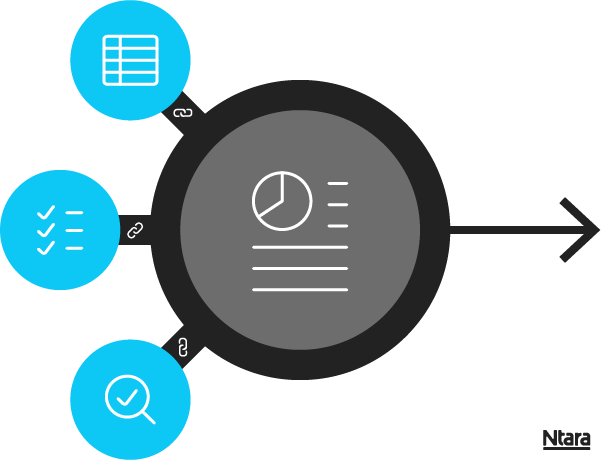
Structured inputs before review
This includes 1) pre-MLR quality gates such as mandatory metadata fields, 2) claims linked to approved references, and component-level , and 3) reuse evidence attached at submission. These inputs reduce revision cycles by giving them what they need at first submission.

Tiered routing designed with reviewers
Since compliance risk varies across assets, they can be managed differently. If Marketing wants to make a new product claim or release new positioning, that can require a full review from Medical, Legal, and Regulatory. Alternatively, you can establish workaround processes with a single reviewer when pre-approved assets are reused.
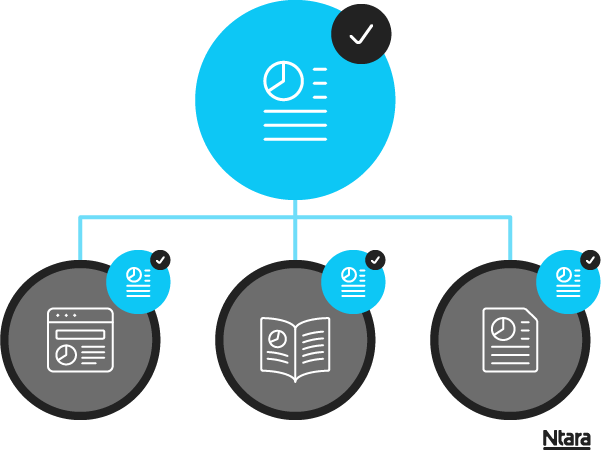
Component lineage that proves reuse eligibility automatically
When an approved content block is reused in a new asset or adapted for a new market, the evidence of prior approval must be surfaced at the point of reuse. To get Regulatory Affairs on board with component reuse, you need a parent-child relationship between components and finished assets. You need the approval history to be visible in the review interface.
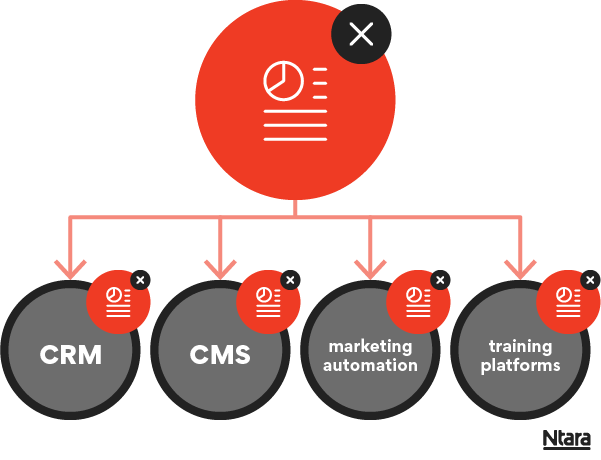
Withdrawal automation across every downstream system
When asset rights expire, you may have processes to retire them in DAM. You also need processes in place to ensure they are automatically retired from downstream channels (CRM, CMS, marketing automation, training platforms) on the same day. There need to be fall back options on each of those systems, as well.
What the results look like when this is done right
We see the same patterns across every organization that has meaningfully improved MLR performance. They stopped treating the review process as something the technology works around and started treating it as something the technology has to support.
These companies engage Regulatory Affairs in the design of routing rules. They build component lineage into the content model from day one, and they automate asset withdrawal before go-live rather than filing it away as a phase two item.
Some mature Life Sciences PXM programs show greater than 70 percent content reuse, MLR cycle time reduced by half, and time from approval to channel-live under one business day. Those results are achievable for companies that view the MLR workflow as the primary design constraint.
The integration architecture is where Life Sciences PXM programs are won or lost
The four trust framework elements above (structured inputs, tiered routing, component lineage, withdrawal automation) are not features you configure inside a single platform. Each one requires precise integration architecture across the systems that touch content: PLM and ERP upstream, PIM and DAM at the center, and CRM, CMS, marketing automation, and training platforms downstream.
Programs succeed or stall in the integration layer. Well-designed systems include automatic audit trails. They execute withdrawal signals on schedule and ensure reviewers get their evidence at the first submission. When this isn’t the case, workflows tend to break at the exact moments compliance depends on them.
The organizations that get this right work with partners who treat integration architecture as a strategic discipline. The right partner will start from the governance model and work backward to the system design, not the other way around. That means understanding how content needs to move before selecting how it’s connected, and designing for withdrawal and reuse eligibility on day one.