
The way buyers discover and evaluate products has fundamentally changed, and it’s still changing. AI agents can now mediate which products get compared and recommended. This shift has implications for how organizations manage product data, digital assets, and their integrations.
Ntara CEO Andy Didyk and Joakim Gavelin, Senior Principal Advisor at Inriver, recently hosted a live conversation exploring how AI is transforming omnichannel product experiences and what it takes to compete in an increasingly agentic buying environment. The discussion was packed with insights that product company leaders need to hear.
If you missed it or want to revisit the details, watch the full webinar replay here.
AI doesn’t just assist; it decides what buyers see
One of the most striking themes of the session was the evolving role of AI in the purchasing journey. It’s no longer just a tool buyers use on the side. AI now sits at the center of the journey. It filters, aggregates, and interprets product information for consumers and business buyers alike.
As Joakim put it, customers may love your brand, but AI decides whether they see your products.
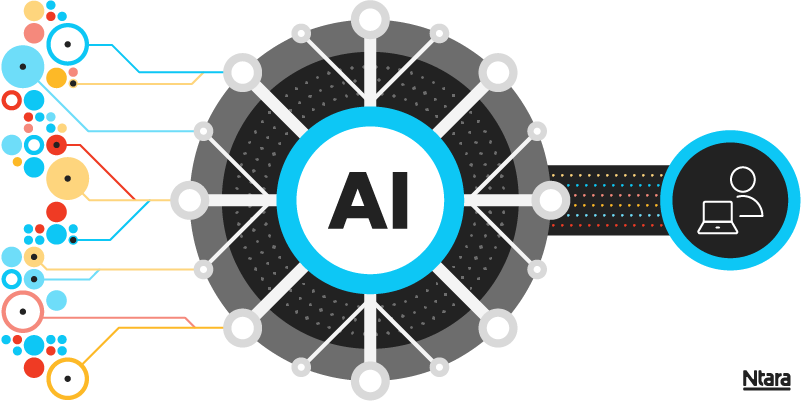
That reality became impossible to ignore when ChatGPT announced agentic commerce capabilities in September 2025, allowing users to search, evaluate, and purchase products entirely within the chat interface.
Andy called it “the bombshell that hit the general public,” noting that it disintermediated the traditional path of visiting a website to make a purchase. While the landscape continues to evolve (with some platforms advancing and others pulling back), the fundamental shift is clear. Organizations are no longer making content and metadata decisions solely for people. Today, they must make them for people and machines.
The PXM foundation must come first
Before organizations can optimize for AI-driven discovery, they need to get the basics right. As Andy pointed out, most haven’t. In fact, only a portion of Ntara’s clients are automatically feeding product content to all current sales channels. Most organizations deploy PIM or DAM to solve a specific use case. Full automation requires rethinking these systems as a centralized, integrated infrastructure that powers every internal and external touchpoint.
AI can only work with the information it can access. If available structured product data is incomplete or inconsistent, products simply won’t surface in AI-driven results. Instead, large language models will fill gaps on their own, and they aren’t known for their accuracy.
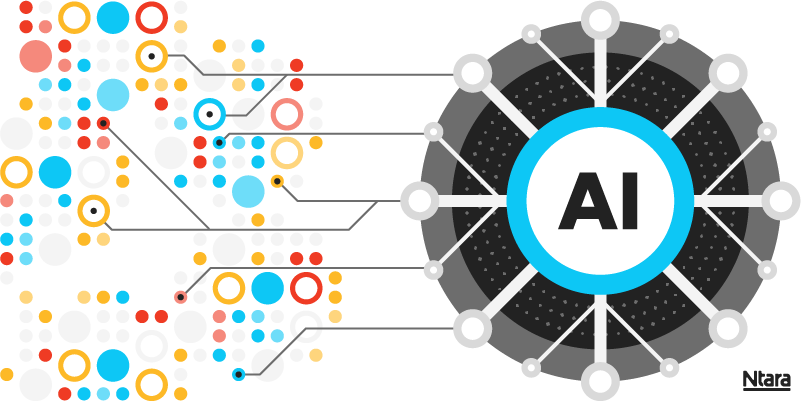
“AI doesn’t know what it doesn’t know,” Andy said. “It’s up to businesses to provide that structured information.”
This isn’t a hypothetical risk. A recent Ntara research report aggregates data from a workshop with 56 B2B commerce leaders. Each ran real-time diagnostics to see how accurately AI answer engines describe their products. The results were sobering. Nearly half found that most of their product knowledge simply isn’t accessible to LLMs today. (Even the well-known brands.
Joakim reinforced the point with findings from Inriver’s recent research on AI in manufacturing. Businesses seeing the greatest returns are those that addressed their data foundation first. Without properly connected systems and governed data, AI processes can’t be trusted. And everyone knows that manual workarounds don’t scale.
Integrated PIM and DAM create experience infrastructure
A recurring theme throughout the webinar was the need to stop treating PIM and DAM as separate back-office systems owned by separate teams. In many organizations, marketing owns DAM, IT owns PIM, and they rarely operate under a unified product experience management (PXM) framework.
That disconnect limits what’s possible. When PIM and DAM are integrated and automated, changes happen once—within PIM or DAM—and propagate everywhere they need to go. And Ntara clients who have achieved this level of coordination have seen time savings of 30% or more. Some have cut time-to-market from 12 months to six, even before applying AI.
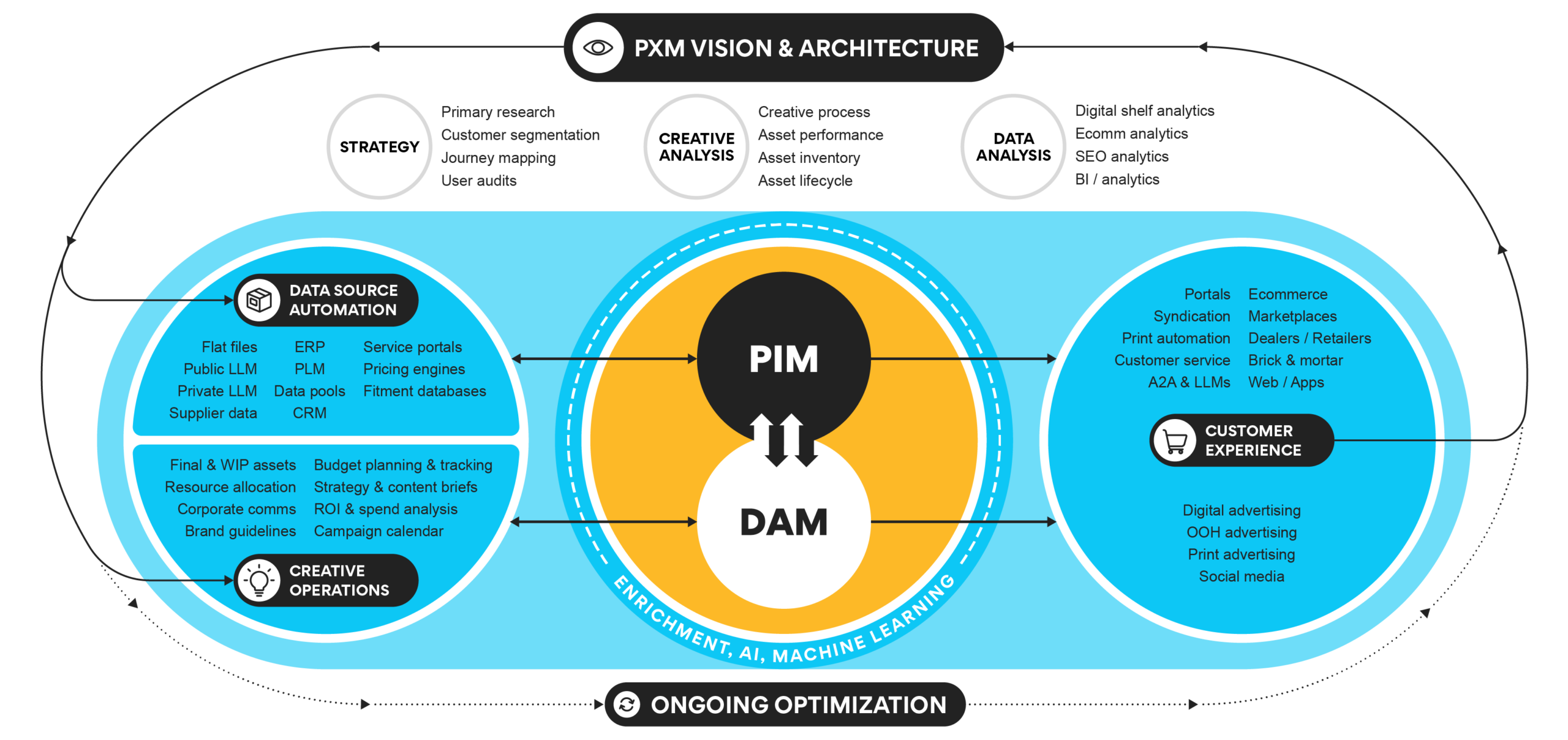
Joakim framed the opportunity clearly: PIM and DAM aren’t just complementary tools. They multiply the value of each other. Accurate product data, high-quality assets, contextual content, and channel-specific adaptations can only be delivered properly when data and assets operate as a unified system.
As Andy noted, getting there isn’t primarily a technical challenge. “It’s usually a people problem” that requires organizational alignment and shared governance. More critically, it requires a mindset shift that treats product experience as a strategic capability rather than a cost center.
Where AI Is already delivering results inside PIM
The conversation also covered where AI is delivering measurable impact today. Not in the future, but right now inside PIM workflows. Joakim said that the highest-impact applications are in data onboarding and validation, i.e., the upstream processes that catch errors before they reach commercial workflows.
AI is now handling more ingestion automatically. It can flag inconsistencies across formats and sources. It can monitor data for completeness, consistency, and compliance during the workflow rather than after launch. Inriver PIM has also introduced agentic capabilities. They have agents that can enrich product descriptions, tailor content for specific channels, and even build further automation into the workflow engine.
The ROI data from Inriver’s customer research backs this up.
- 66% of respondents reported reduced time spent maintaining data.
- 75% said they can launch products faster.
- 50% reported fewer compliance issues.
On the commercial side, customers reported significant ROI, as well.
- 21% decrease in product returns
- 16% product revenue growth rates
- 7-percentage-point reduction in customer churn
What the most advanced organizations are doing differently
What separates the most advanced organizations from others? It’s all about mindset and structure.
Andy explained that eading organizations have established PXM centers of excellence, with ties to the CDO or CTO. They understand that the lifeblood of their business for discoverability and purchasing is the quality and consistency of their product data. Some have deployed AI agents that enrich data around the clock. Others are building applications using MCP servers that enable agent-to-agent communication within and beyond the PIM.
Andy also shared practical advice on what drives AI citations over competitors:
- Having pricing visible (even MSRP) as a trust signal
- Answering questions consistently on your website
- Ensuring content has human authorship
- Keeping content fresh
Watch the full replay
This recap captures the highlights, but there’s much more in the full playback, including:
- Deeper discussion on compliance and digital product passports
- The right PIM-to-DAM workflow
- How to think about the “micro-attribute” data that unlocks long-tail AI use cases
Watch the full webinar replay here to get the complete picture and start mapping your next steps.