
If you are like most manufacturers, your AI strategy is already underway. Our research found that 79% of senior manufacturing leaders have a strategy in place and have already begun implementing it.
Here is the part of that statistic that gets less attention: only 7% of those same organizations describe their product information flow as fully integrated across all their systems.
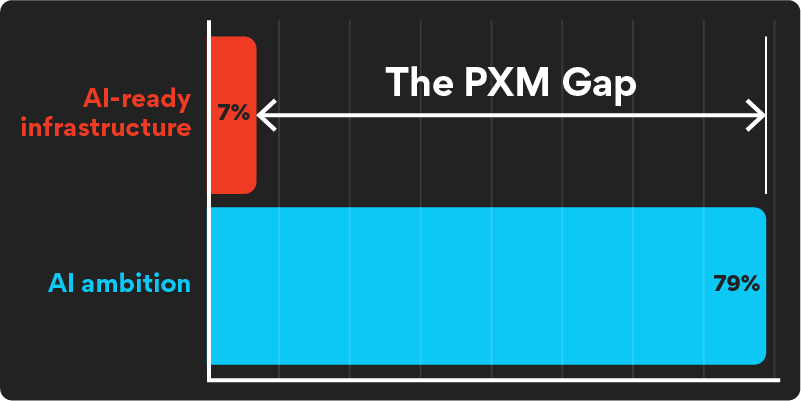
That gap—AI strategy without integrated infrastructure—is the subject of this article and the central finding of ‘The PXM Gap,’ a study of 100 industrial manufacturing leaders commissioned by Ntara, Inriver, and Bynder.
What AI tools need that most companies cannot provide
The most common AI use cases manufacturers are pursuing right now are practical. They’re structuring product data so AI tools can read and use it more effectively (54%), deploying AI-assisted product discovery for customers (43%), and automating product content syndication to channels (40%).
All those use cases require the same thing: accurate, complete, and consistently available product data that flows automatically between systems.
When product data is incomplete or manually maintained, AI tools trained on that data reflect the same gaps. When it is inconsistent across channels, AI-assisted discovery returns unreliable results. When syndication is manual, automating it with AI adds a layer of complexity to a process that is already failing.
Garbage in, garbage out—at scale
This principle is not new, but AI changes the magnitude and consequences.
A manual process with bad data produces bad outputs at the pace of humans. An AI system with bad data produces bad outputs at the pace of machines. The errors are faster, more frequent, and harder to audit.
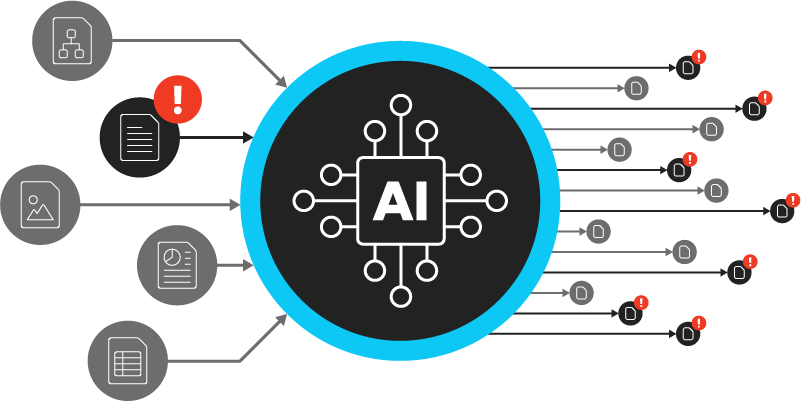
Half of the manufacturers in our study reported experiencing data security or governance risks due to ungoverned product content in the past 12 months. That was before most of them had AI actively running on that content. When AI tools are added to a fragmented data environment, governance risks do not decrease. They scale.
Legacy infrastructure is the upstream problem
For many manufacturers, the integration gap is not a failure to prioritize. It’s structural.
More than half (52%) cited legacy technology that is difficult to connect with modern systems as a top barrier. And legacy systems were often the reason product data became fragmented in the first place. They were built before modern APIs, before cloud architecture, and before the expectation that product content would need to power a dozen downstream channels simultaneously.
Those same systems are often resistant to the API-based integration that modern AI tools require. For companies that also lack internal integration expertise (46% in our study), the path to AI readiness runs directly through a set of infrastructure problems they don’t have the internal resources to solve.
The organizations that are further along
Among the 11% of manufacturers who describe their AI implementation as mature, 36% have fully integrated product information systems. That is more than 10 times the rate of organizations just beginning AI implementation, where only 3% are fully integrated.
These companies did not skip the foundation work. They invested in integrating PIM and DAM at the center of product content operations before scaling AI. The data in our study suggest that this sequencing matters.
What to do before you scale AI

It’s critical to build upon on a scalable foundation. The report’s key suggestions for manufacturers building AI-driven commerce:
- Audit the effectiveness of your current technology integrations before expanding your stack. Map where product data flows today and identify where manual processes are filling gaps. Those are the gaps where AI initiatives will stall first.
- Treat PIM and DAM as a symbiotic system—recognize that integration as the starting point. The value comes when both systems are connected, governed, and automatically feed consistent product content to every channel.
- Make complete, well-enriched product data a requirement for product launch. Customers and downstream AI tools both depend on accurate, comprehensive information being available at launch.
- Build the business case for integration work by connecting it to revenue outcomes. With 42% citing difficulty justifying ROI as a barrier, internal investment in PXM infrastructure needs to be framed in terms of time-to-market, channel performance, and reduced manual costs.
- Evaluate outside partners sooner rather than later. Among manufacturers in our study, 88% are already working with or evaluating a PXM partner. This indicates a great need for companies that aren’t yet in pursuit.
The full report is free to download. If you want to assess where your organization’s data infrastructure stands before your next AI initiative, reach out to start the conversation.