Taxonomy is invisible when it’s right. Painful when it’s wrong.
Customers don’t notice a well-built taxonomy. When they’re built well, customers can easily find and compare products and complete purchases. But when taxonomies have errors such as mismatched attribute names or competing category structures, every downstream system suffers. And as your SKU count and channel count grow, the problem compounds.
Taxonomy isn’t typically a one-time decision, especially for companies managing complex catalogs across multiple product lines, categories, and geographies. It’s an ongoing discipline that requires a framework built to scale.
What global master taxonomy includes
Ntara builds taxonomy frameworks that organize product information to meet both internal governance standards and external channel requirements simultaneously.
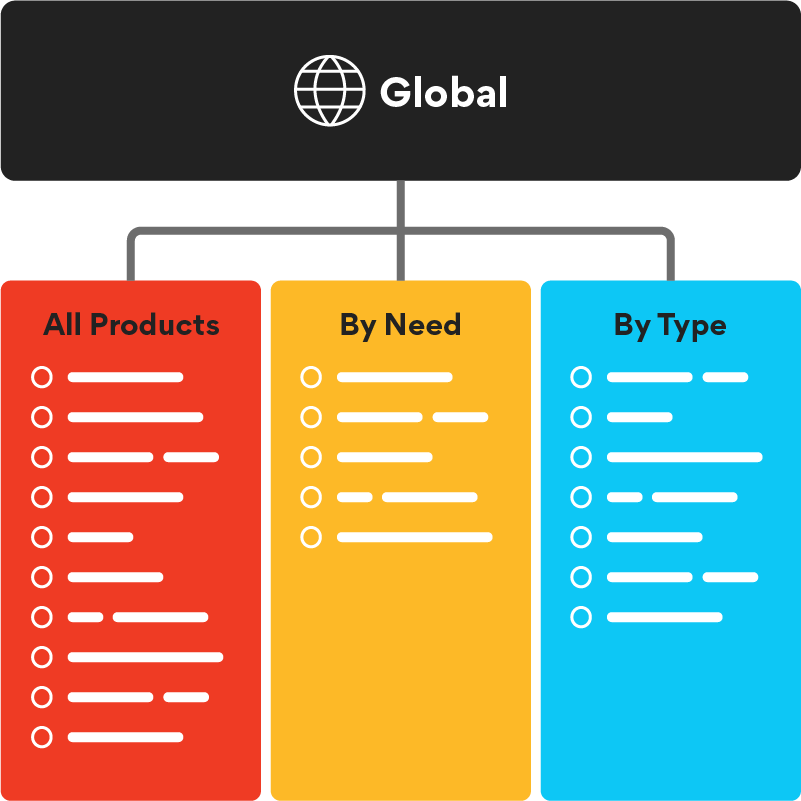
Category hierarchy design: A logical, hierarchical structure for your product catalog that maps to how your customers search and how your channels expect to receive data.
Attribute framework: The set of attributes required at each level of the hierarchy, with definitions, data types, acceptable values, and unit-of-measure standards. No redundant attributes or gaps.
Channel mapping: How your master taxonomy maps to the requirements of specific downstream channels such as ecommerce, distributors, retailers, marketplaces, and print. One master structure with channel-specific outputs.
Naming and value standardization: Controlled vocabularies and normalization rules that eliminate inconsistencies at scale. The same attribute name and accepted values every time.
Governance documentation: The rules that determine how taxonomy evolves as your catalog and channels change. Things like who can propose new categories or attributes, how changes are reviewed, and how legacy data is migrated when the taxonomy updates.


Taxonomy that enables channel syndication
A well-governed master taxonomy is what makes reliable syndication possible. Without it, every new channel requires custom mapping work, manual cleanup, and ongoing reconciliation. With it, product data flows seamlessly downstream to retailers, distributors, marketplaces, and whatever channels come next.

What this looks like in practice
Royal Brass & Hose needed to move thousands of hydraulic and pneumatic parts from a manual order process to a self-service ecommerce model. Before any of that was possible, they needed to get their products findable, filterable, and purchasable online. To get there, they needed a taxonomy framework.
We worked together to get a structured taxonomy and new PIM platform in place. Since then, Royal Brass & Hose has achieved 8% ecommerce growth year over year. They also save 40 hours of order entry time whenever a product field is updated.
Columbus McKinnon manages 77,000+ SKUs across 19 global brands. The bidirectional integration we built between their PIM and DAM depends entirely on taxonomy and metadata model to keep both systems aligned. When assets and product data are consistently tagged and attributed, the sync between PIM and DAM is automatic.
What you get
- Documented global master taxonomy framework
- Category hierarchy, attribute definitions, and controlled vocabularies
- Channel mapping for your primary downstream destinations
- Governance documentation and change management guidelines for taxonomy maintenance
Ready to build a PIM strategy that holds?
Let’s schedule a discovery call to understand your current state and define what “done” looks like for your business.