
If you make tools for a living, you already know the pressure is coming from multiple directions.
Trade verticalization means your catalog is growing and splitting. Every drill platform now needs a professional-trade variant with its own spec depth, and a DIY variant with content that speaks a completely different language to a completely different buyer.
Tariffs have made the cost of manual content work impossible to ignore. When margin gets this tight, every duplicate feed and every copy-paste error shows up on a P&L instead of just an IT ticket. And if your brand portfolio grew through acquisition, you inherited someone else’s taxonomy along with their revenue. That means your “one company” is really three or four companies pretending to share a system.
Unfortunately, a PIM go-live doesn’t fix any of that. You can only fix it in the years after.
We know this at Ntara because we’ve lived it. We’ve worked with a tool manufacturing client for five years now. What follows is that story. Not as a highlight reel, but as four honest chapters, each one solving a real problem and each one setting up the next.
First, a quick definition
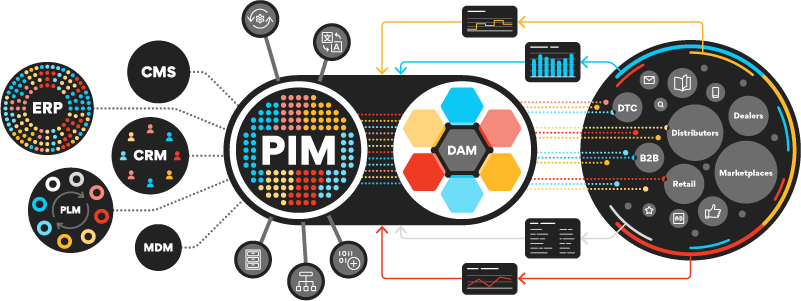
Product experience management (PXM) is what you get when PIM (the system of record for product data) and DAM (the system of record for digital assets) stop operating as two separate tools and start operating as one governed pipeline. That includes everything from your PLM or ERP, through enrichment and approval, out to every channel and every distributor. PIM and DAM are both critical. The conversation has to start with strategy. Tooling comes second.
Chapter one: a PIM rescue, and a UI nobody could use
This engagement didn’t start as a success story. It started as a rescue. Their first PIM implementation wasn’t delivering, and they needed a new partner to make it work.
Once they addressed some core data issues, a second problem surfaced: with 2,000+ product attributes live in the system, the interface itself had become the bottleneck. Data entry teams described it as an endless scroll, requiring tab after tab and category after category just to find one field.
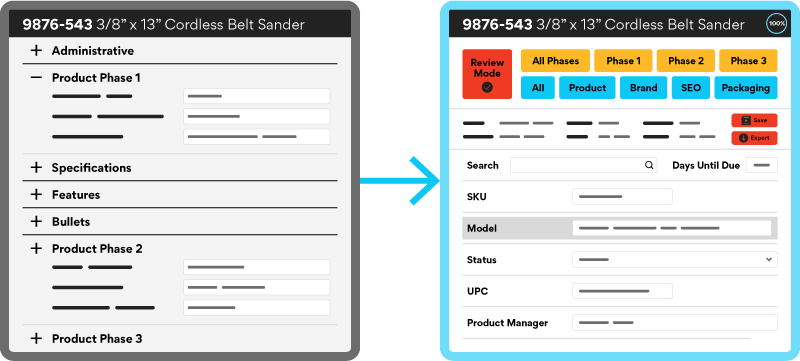
That’s the stage most manufacturers recognize but rarely say out loud. When the platform is live, the investment is real, but people still can’t do their jobs in PIM. Our team of certified Inriver Champions built a custom review-mode interface with filtering by phase, department, and due date. Within beta, system usability jumped from 30 to 70 on a scale of 100. Across 200+ users, time spent in PIM dropped by roughly half. One brand coordinator on the account said the ability to make copy edits directly during approval was a genuine game changer for her day-to-day.
That’s worth sitting with for a second. The win here wasn’t a new platform. It was making the platform they already owned usable enough for people to actually trust it.
Chapter two: adoption is a design problem, not a training problem
Here’s the pattern we see across manufacturing: when a team doesn’t understand how a system helps them or why a field matters, they route around it. And once people route around the system, the data degrades no matter how good the platform is.
That’s the real lesson from chapter one. Usability isn’t nice to have. It’s the mechanism that decides whether your data stays clean after go-live. Get that part wrong, and everything downstream inherits the mess, from syndication to reporting to ecommerce.
Chapter three: the next bottleneck you didn’t know to ask about
So, this tool company had its data foundation in order and people were trusting and using the system. Then, a new problem showed up, one that no one had identified at kickoff. Marketers had no efficient way to order digital assets by SKU across channels. That meant a PDP could be technically accurate but still show the hero image in the wrong slot.
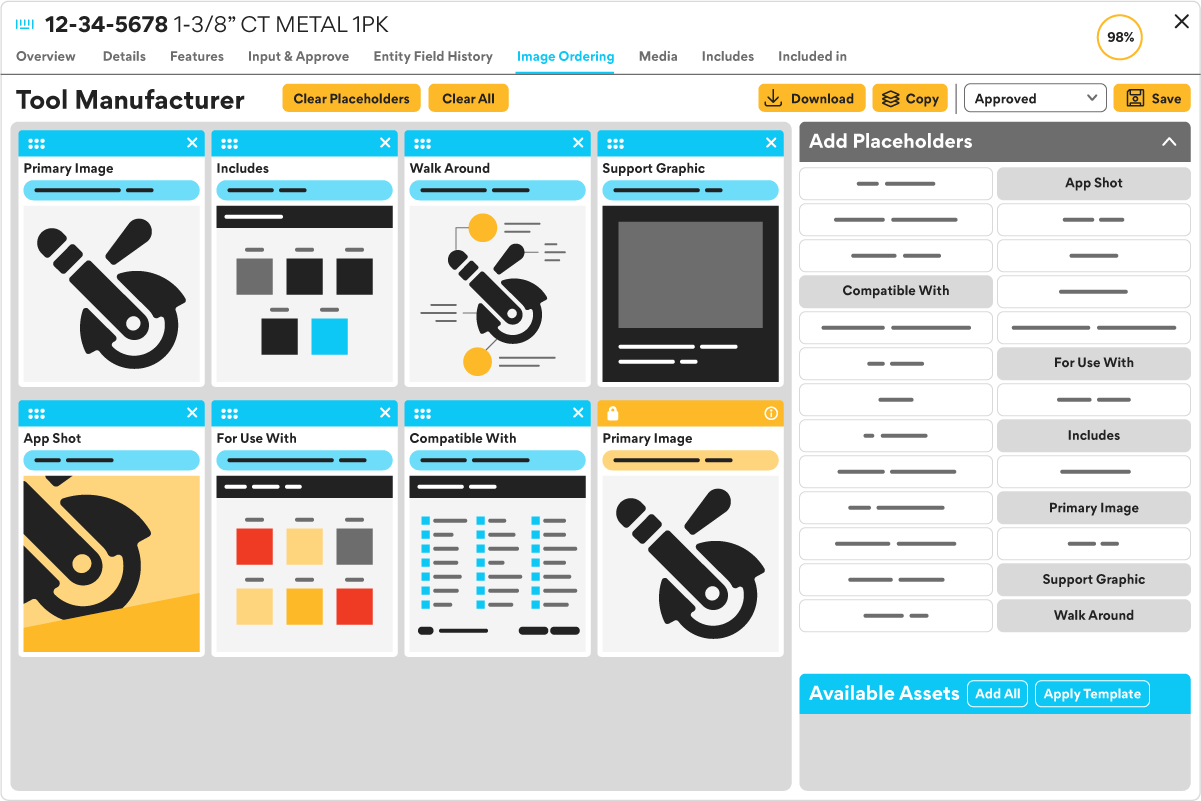
Rather than bolting on a new point solution, we scored 20+ requirements against vendor tools and APIs. Then, we built a custom asset-ordering interface directly inside the existing Inriver platform. It offered drag-and-drop reordering, preset templates for recurring SKU types, and placeholder tracking so a missing asset could never block approval. Today that single interface manages 11,000 assets across a catalog of 18,000 SKUs, and syndicates 2,300+ images from PIM straight to Sitecore.
ROI from a PIM and DAM investment doesn’t stop at go-live. It keeps compounding as new use cases are surfaced. It gets critical problems out of the way, so you can focus on features that empower users. This requires honest, cross-functional alignment about what should be automated – and the investment of time and resources to support it.
Chapter four: PIM becomes what the company runs on
Three to five years in, the conversation with this manufacturer changed shape entirely. It stopped being “how do we fix PIM” and became “where does this data need to go next, and what do we risk by not moving.”
That shift didn’t happen automatically. They earned it. At an annual, internal showcase, where teams present their best digital work directly to leadership, the PIM team presented its PXM ROI story. That was the exact moment PXM stopped being an IT initiative and became a company-wide operating model.
At this point, the numbers make the case on their own:
- A consistent six-month concept-to-launch cycle
- 78% reduction in PIM fields
- 416+ hours saved every year through automation
- Duplicate platforms consolidated with real licensing-fee savings
The manufacturer now runs digital shelf analytics inside Inriver PIM, which scans retail sites for content inconsistencies before a customer ever notices. And they’re now piloting AI and translation projects on top of the same foundation.
Summary: the stuff you should pass along to your teams
A few things carry across every stage of this journey, and we’d bet they carry across yours too:
- Executive support must be earned. The real inflection point here, where everyone “got” PXM, was a leadership presentation, not a system upgrade.
- Data foundation comes before integration. Every later chapter only worked because the data model and interface got fixed first.
- Adoption is the ROI lever. A well-integrated PIM that people avoid using delivers none of its promised value — a usability score is as real a metric as a SKU count.
- The next bottleneck is always specific to your business. Asset ordering, distributor syndication requirements, spec depth for a licensed tradesperson versus a weekend DIYer — none of that shows up in a discovery workshop. It shows up once the foundation is solid enough to expose it.
The mistake we see most often
Treating the first go live as the finish line. It isn’t. Your first go-live starts the adoption curve. The manufacturers still fighting to prove ROI years later are usually the ones who stopped investing the moment the system went live.
Where does your team sit on this path?
Maybe you’re in the middle of a PIM implementation. Maybe adoption is quietly undermining the ROI of a platform you already paid for. Maybe you have a solid foundation, and you’re staring down the next bottleneck that nobody flagged at kickoff.
Wherever you are, other manufacturers (including this one) have already walked this path, and we’ve walked it with them.
If you’re evaluating a new PIM or DAM implementation, or a full replatform, it’s worth knowing that Ntara backs new implementations with an ROI guarantee within 24 months of go-live, supported by up to 20% of your implementation cost in service credit if the project falls short.