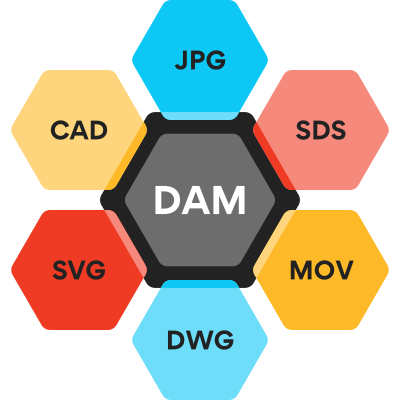
A DAM your team will actually use
The most common failure mode in DAM implementations is the gap between the business needs and the configuration.
Taxonomy must be designed for how users actually search. The metadata model must reflect real-world asset types. Integrations must be built for purpose, not just spec. And go-live must be treated as the starting line, not the finish line.
Ntara has worked alongside product companies through all this. We’ve rescued DAM implementations where another partner left massive gaps in strategy. Our practice is designed to close them from day one, and our DAM implementations are backed by an ROI guarantee.
The industry’s first ROI guarantee on DAM implementations
Ntara’s DAM implementations now come with an ROI guarantee. Positive return within 24 months of go-live (often sooner!) or we invest up to 20% of your implementation cost in services to help you get there.
Learn more
What sets DAM implementation apart from onboarding
DAM onboarding is the foundational layer of implementation. It includes the initial configuration and admin training that get your platform up and running. Implementation includes that layer and builds on it. It’s the full build, designed for your specific use cases. It includes the integrations to systems your team already uses, as well as governance structures that will hold up at scale.
If you haven’t started yet, implementation begins with onboarding as its first phase. If you’ve already onboarded your DAM platform, implementation picks up from there.
Six phases of Ntara’s DAM implementation
Onboarding: Foundational configuration, permissions, and admin training to get the platform running. If you’ve already completed this, we start with the next phase.
Discovery: On-site or virtual workshops to map your current state, including asset types, metadata requirements, team workflows, and downstream distribution needs. We conduct a DAM analysis before making a single configuration decision. This tells us what you manage, how your team produces and enriches assets, and where they need to go. It shapes our approach to the build.
Design: Taxonomy architecture, metadata model, and governance design tailored to your library and channels. This is the foundation on which everything else builds. A poorly designed taxonomy creates years of remediation work that no amount of optimization can fix.
Configuration: Full DAM configuration scoped to your use cases, including workflows, permission profiles, user groups, derivatives, and any additional modules. This includes roles and review paths that your team can actually run.
Integrations: Bidirectional integrations with PIM, ecommerce platforms, CMS, ERP, and more. Standard scope includes the integrations required to make your DAM the hub for asset distribution. Syndication endpoints can be added to support downstream delivery to distributors, retailers, and digital channels.
Enablement & launch: Training, hypercare, and a documented runbook. This is the handoff that makes adoption stick, and what separates a go-live from a successful launch.

Certified across leading platforms
Ntara holds many DAM vendor certifications and brings multi-platform depth to every engagement. We partner with leading DAM platforms and have the cross-platform experience to recommend and implement the right solution for your specific requirements.
What to expect
Standard scope: Full taxonomy and metadata model; configured permission profiles and user groups; platform-specific module configuration; integrations to key upstream and downstream systems; admin training and hypercare runbook
Timeline: 16 to 26 weeks depending on integrations and module scope
Deliverables: Configured DAM with taxonomy, governance framework, integrations, and a hypercare runbook

What this looks like in practice
When Columbus-McKinnon needed to modernize product content operations, Ntara implemented a PIM and DAM in parallel. We connected 77k SKUs and 16k digital assets across 19 regions and languages. We also automated the migration of assets and metadata, synchronized data sharing between PIM and DAM, and established a closed loop to send metadata from PIM to DAM. As a result, marketing moved from a manual, siloed process to centralized enrichment with governed downstream syndication.
When Bouclair needed a fast upgrade to a scalable DAM with automation features, Ntara completed the migration of 85k digital assets in two weeks. And we did it on time and on budget. To get there, we conducted a joint discovery to architect the DAM. Then, we updated their legacy metadata models and integrated DAM with PIM—all without interrupting data syndication to their ecommerce site.
When DAM implementation makes sense
- You’ve completed DAM onboarding and are ready for a full configuration build
- You’re replacing an existing DAM that no longer meets your scale or governance requirements
- You need integrations between your DAM and PIM, ecommerce, CMS, or ERP
- You’re launching a new product line or channel that requires a governed asset distribution workflow
- You’ve outgrown a manual or siloed asset management process
Ready to implement a DAM that delivers?
Let’s schedule a discovery call. We’ll map your current state, define your requirements, and scope an implementation built for your business.